The Scene Is Not "AI Strategy." The Scene Is A Stressed User Who Needs Help Now.
A medical-device company should not start this conversation by saying it uses AI.
It should start with one concrete scene.
A user is uncomfortable, rushed, uncertain, or under operational pressure. They do not want a library. They want the next right step.
That is why the ideal entry point may be simple: a QR code on the package, the device, the insert, or the support card. The user scans it with a phone camera and lands on the exact support surface for that product, version, and use context.
The page should not begin with long paragraphs. It should begin with what helps under pressure: the right image, the right short video, the right guided steps, and a way to ask by voice if the user does not know what to search for.
- show the current Product ID, version, and relevant support state;
- surface the top recurring questions for that exact product context;
- offer illustrations before dense text when illustrations reduce stress faster;
- offer short videos when motion explains the task better than paragraphs;
- let the user speak naturally if they cannot describe the issue in formal product language.
The Goal Is Fast Resolution, Not A Fancy Interface.
Most support demand is not exotic. It is repetitive, practical, and time-sensitive.
That is exactly why it deserves careful design.
If a company puts enough thought into these repeated moments, it can solve eighty to ninety percent of them faster, more clearly, and with less stress for the user.
The point is not to impress the user with technology. The point is to reduce friction so the user can solve the problem and get back to safe, confident use.
- The user should not need to read a long article before acting.
- The support surface should reduce choices, not add them.
- The first screen should help the user act, not educate them broadly.
- The system should know when self-service is enough and when to escalate.
Product ID Is The Base Layer That Keeps The System Honest.
This kind of support only works well if the company runs from one shared product truth.
That truth should sit on one Product ID.
The Product ID is not only a product name. It is the operating identity of that product: what it is, which version is involved, what evidence and instructions apply, what known issues already exist, what prior service signals matter, what quality and labeling decisions were made, and what actions are still open.
Without that base, support becomes fuzzy. Service, product, RA/QA, engineering, and sales may all think they are talking about the same thing while actually looking at different fragments.
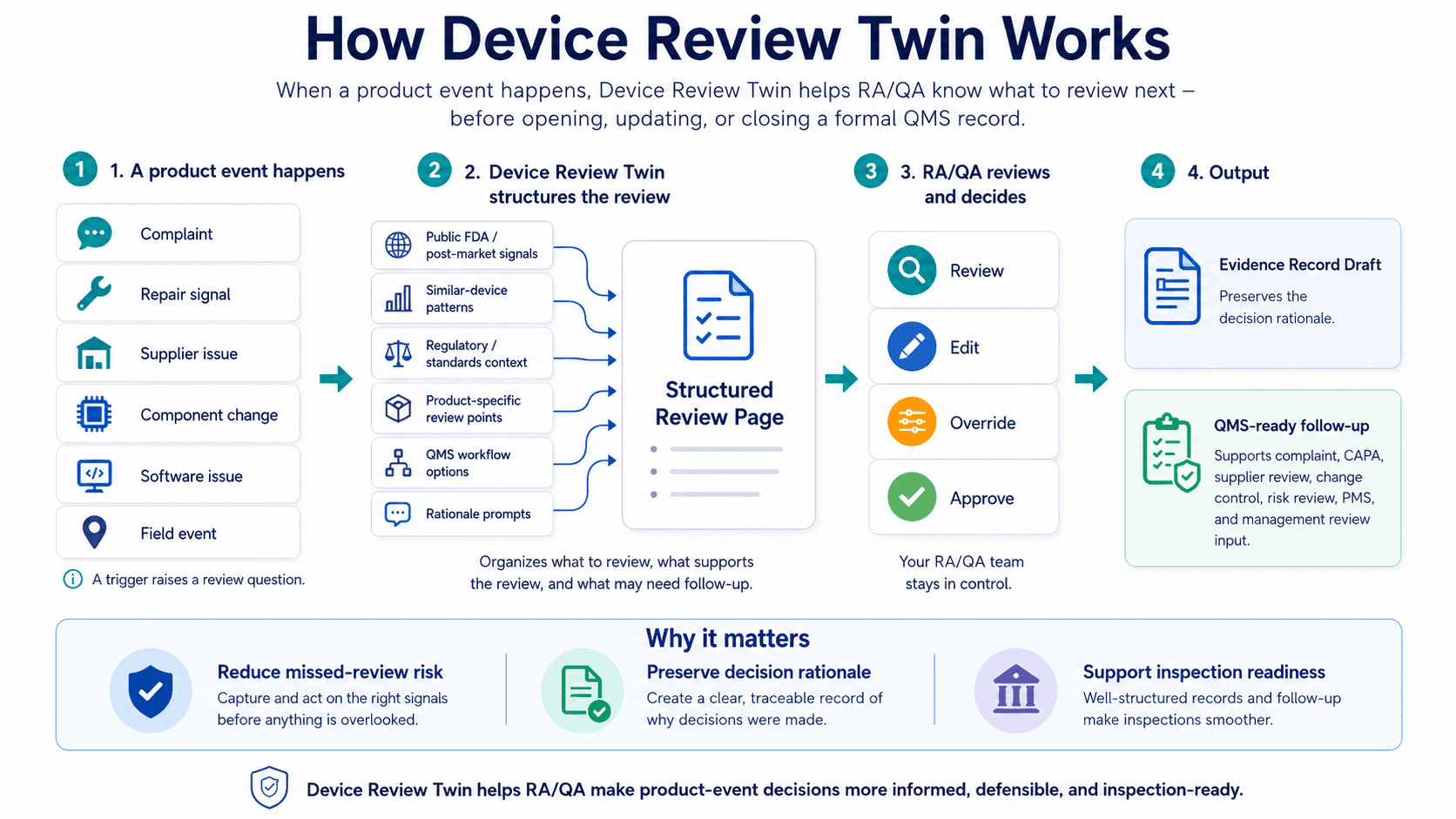
- customer support should attach to one Product ID;
- quality review should attach to the same Product ID;
- engineering scope should attach to the same Product ID;
- commercial learning should attach to the same Product ID;
- future inspections should retrieve the same Product ID history.
AI Should Appear Only Where It Truly Helps.
The wrong design says: put AI everywhere.
The better design says: keep fixed, repeated, high-confidence work inside code, scripts, rules, structured content, and deterministic routing. Let AI appear only where interpretation, matching, summarization, or retrieval across many records is actually useful.
For example, AI may help translate a spoken customer question into the right Product ID context, identify likely matching issues, pull the best illustrations or videos, summarize what the user already tried, and prepare a concise handoff if human support is needed.
That is very different from asking a general model to improvise the whole support experience.
- rules and code should handle the stable parts;
- AI should handle the uncertain, language-heavy, context-matching parts;
- human review should stay in the loop where risk, ambiguity, or escalation matters;
- the system should never depend on one model hallucinating its way through a safety-sensitive scene.
Every Support Moment Should Become Product Memory.
The support interaction should not disappear after the user gets an answer.
It should leave a trace.
What did the user scan? What did they ask? Which content solved the issue? Which issues repeated? Which ones failed self-service and needed a human? Which questions kept coming back for the same Product ID or version?
That memory is where the real company value starts to build.
The system can review those patterns while the team sleeps. It can summarize the last week, detect repeated support themes, suggest which team needs to review them, and surface the morning report to product, service, RA/QA, engineering, or leadership.
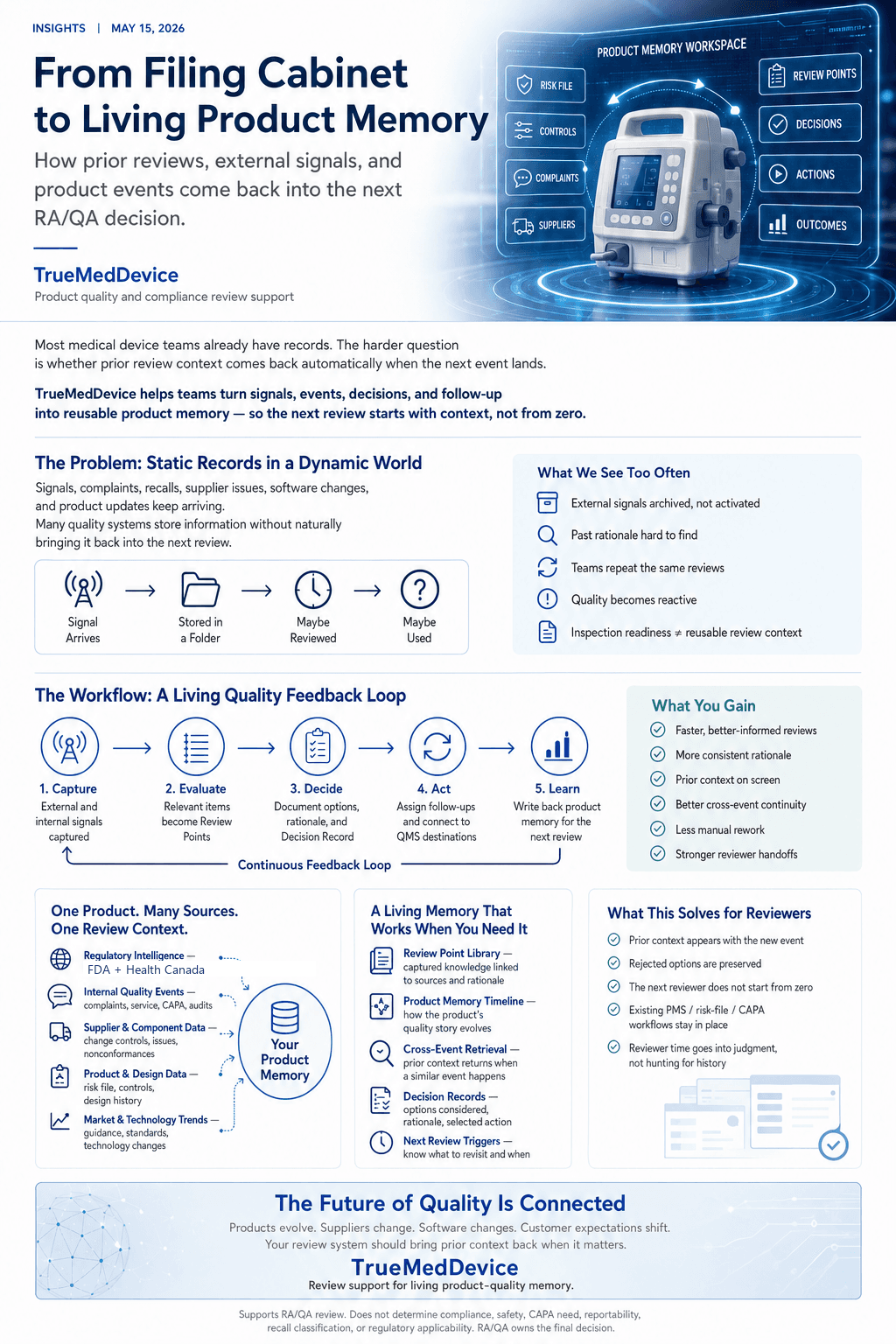
- repeated user friction can become a product-improvement signal;
- repeated service confusion can become a training or labeling signal;
- repeated quality-adjacent issues can become a review signal for RA/QA;
- repeated commercial hesitation can become a market-message or onboarding signal.
A Good System Knows When To Keep The Problem In Self-Service And When To Move To A Human.
Good support design does not trap the user in automation.
It uses automation to remove the obvious, repeated, and well-understood cases first.
Then, when a human takes over, that person should already receive a narrowed problem space. The system should have filtered out many low-value repetitions, attached the right Product ID context, and shown what the user already saw or tried.
That improves user experience and lowers repetitive support cost at the same time.
- self-service should solve the obvious repeated cases;
- AI should organize the ambiguous middle layer;
- humans should receive the higher-value, higher-risk, or unresolved cases with context already attached.
This Is Also How A Company Gets Closer To Reorders, Retention, And Safer Growth.
A company often says it wants to be closer to the customer.
This is one concrete way to do it.
If the company can see what users repeatedly struggle with, what they repeatedly ask, what they repeatedly succeed with, and what makes them trust the support experience, it understands more than support. It understands why the customer would come back, reorder, or recommend the product again.
At the same time, it sees what may later turn into larger quality or field issues if left unresolved. That is why this operating loop is not only a service feature. It is a risk-control loop and a product-learning loop.
The Point Is Not To Sell AI. The Point Is To Solve One Real Scene Well.
The right operating question is simple.
Who, in what scene, needs help with which problem?
If the company can answer that clearly, then it can decide whether AI should be involved, where Product ID should anchor the memory, what should remain deterministic, what should route to human review, and how the company should learn from the interaction afterward.
That is the right attitude toward AI in a medical-device company.
Not as the point of the system, but as one tool inside a stable, repeatable, high-quality operating loop.
What To Design Before Calling This An AI Support System
Start with one stressed-user support scene, then design the loop backward from resolution, evidence, and Product ID memory.
- 1Define one real support scene where users lose time, clarity, or confidence.
- 2Decide what the user should see first on the support page: image, video, step list, or voice prompt.
- 3Attach the scene to one Product ID, version, and support history.
- 4List which repeated cases should stay deterministic and rule-based.
- 5List which cases need AI only for matching, summarizing, or retrieval.
- 6Define the human-escalation trigger and the handoff context that must travel with the case.
- 7Record which repeated support issues should flow into engineering, labeling, training, service, or RA/QA review each week.
- 8Set a morning review habit so the company learns from the last week's repeated support scenes instead of only reacting case by case.
Source ledger
These sources are used to organize questions and public context. They do not make the final product-specific decision.
Can help establish
The Food and Drug Administration (FDA) explains that medical-device labeling supports safe use, including instructions, warnings, and product-specific communication boundaries.
Cannot decide
Whether one company's support workflow, packaging support pattern, or product-specific communication design is sufficient for every use situation.
Can help establish
FDA explains how a device identifier supports product traceability and version-specific product reference.
Cannot decide
How a company should structure its internal Product ID memory, service workflow, or customer-support operating model.
Can help establish
FDA describes why device use conditions, user stress, task flow, and use-related risk matter in product design and validation.
Cannot decide
Which support content, support interface, or support escalation workflow is best for a specific company or device.
Can help establish
FDA explains that device problems, malfunctions, and adverse-event signals must be recognized and handled with care.
Cannot decide
How one company should route every service signal into product, quality, engineering, or customer-success review.
Can help establish
FDA inspection materials show that companies need traceable problem handling, investigation, and action logic.
Cannot decide
Which internal memory system, automation rule, or AI-assisted operating loop is the right fit for a specific team.
FAQ
Why not just give the user a full manual and a chatbot?
Because the stressed user usually needs the next right step, not a large document set. A useful support system should reduce friction, narrow choices, and attach the right Product ID context before asking the user to read broadly.
Should artificial intelligence (AI) answer every support question directly?
No. Stable, repeated, high-confidence tasks should stay inside deterministic content, code, scripts, and routing rules. AI should appear only where matching, summarization, or retrieval across many records truly helps.
Why does support need to connect to Product ID instead of staying in a separate service tool?
Because support questions are also product, quality, labeling, and commercial signals. If they do not connect back to one Product ID, the company loses memory, duplicates effort, and struggles to turn repeated user friction into repeatable improvement.