From scattered information
to something you can discuss.
Understand the opportunity
Market research & open questions
Explain the product
Visual cards for sales, training & support
Check the record
Dated sources & follow-up questions
A defined scope. Traceable sources. Clear review responsibilities.
CLEARCARD · FOR MEDICAL-DEVICE AND EQUIPMENT MANUFACTURERS
Can your customer find the right next step?
A customer has a question about a feature, a setting or an error code. Your manuals may contain the answer. How many steps must they take to find the part that applies to their product?
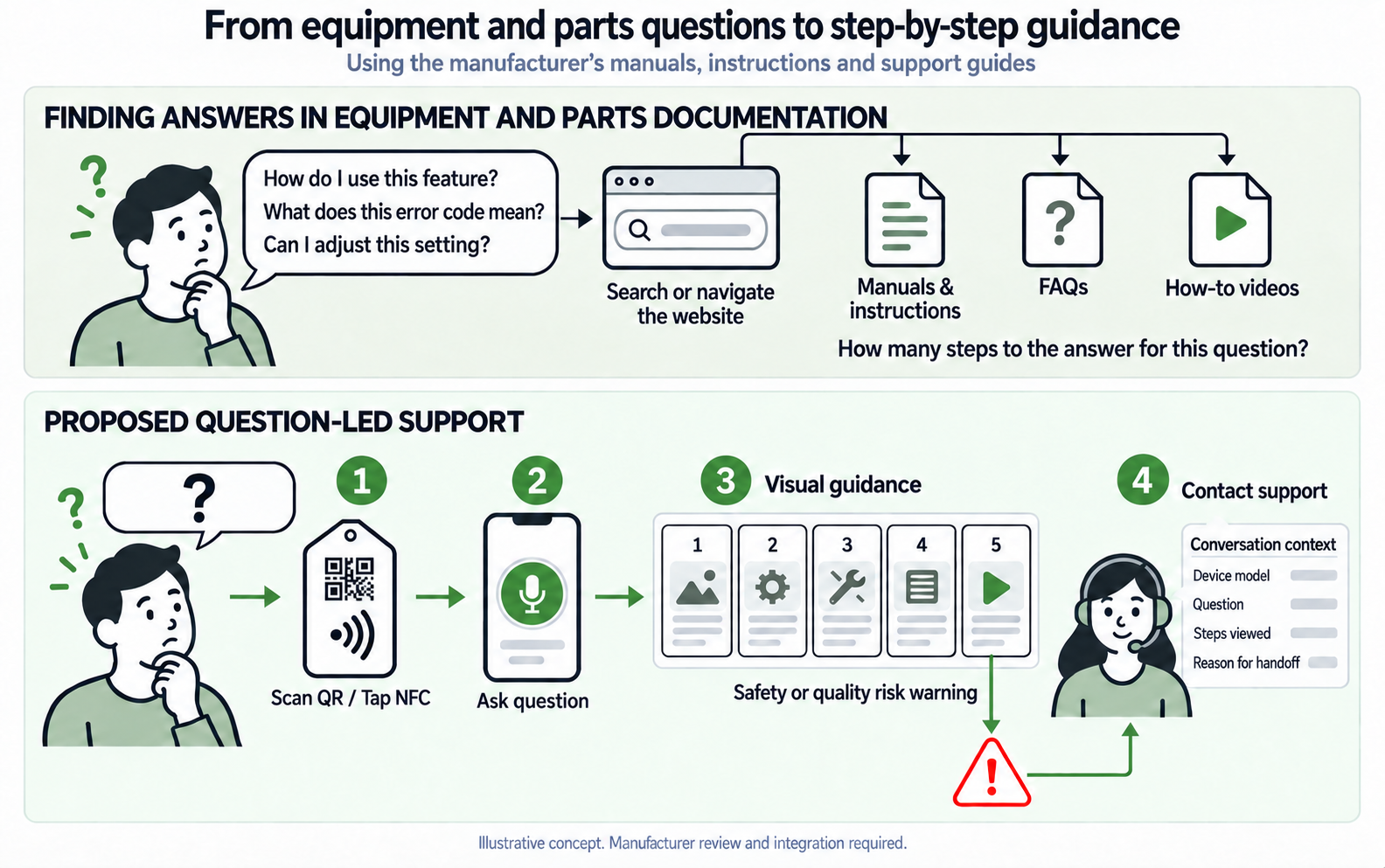
Illustrative concept in English. Manufacturer review and an agreed implementation are required.Open the full-size diagramRead the diagram as text
The customer asks about using a feature, an error code or an adjustable setting.
Current documentation route: search the website, locate the relevant manual, frequently asked questions or how-to video, then find the applicable answer.
Proposed route: scan a quick response (QR) code or tap a near-field communication (NFC) tag, then ask the question by voice or text.
View the relevant manufacturer-approved visual steps. The diagram shows five example cards; actual paths and warnings depend on the product.
Before an action that may pose a safety or quality risk, show the manufacturer's approved warning, ask the user to stop and contact support. The proposed handoff includes device model, question, steps viewed and reason for handoff.
One product. One question. A review-ready visual path.
ClearCard organizes your existing instructions into a visual support path for your team to review. After approval, users can reach the applicable fixed image cards by voice or text, see the relevant warnings before an action, and find the agreed human-support route.
An answer that fits
Keep the product, model and source version attached to the guidance.
A visible stopping point
Place your approved warnings and support contact at the relevant step.
Context for your team
Prepare the model, question, steps viewed and reason for handoff.
Share one product and one recurring question. Agree the first deliverable and review owner.
Your designated reviewers approve the content and release. Hosting, usage records and support-system integration need an agreed scope. This service cannot guarantee user compliance or eliminate every use error.
START WITH YOUR QUESTION
What needs to be clearer right now?
Choose the result your team needs. Each service can start with one product and one defined question.
01
Is this market worth pursuing?
Bring market, comparator and entry-route evidence into your planning discussion.
Keep sales claims and use guidance consistent with the device's authorized use. Prepare visual cards for manufacturer review across buying discussions, training and support.
A structured starting point for discussion, shaped around your product and question.
Illustrative structure · no product findings
One product. Three conversations.
Give sales teams, clinicians, buyers and users clear material that stays consistent with the product's intended use, evidence and limits.
Source material
Explain
Train
Support
Manufacturer review
01
Sales & buying discussions
Explain the problem solved, differences from the current solution and adoption costs
02
User training
Show reviewed steps and explain key checks
03
Support during use
Clarify the question and when to seek human help
Overstated claims or misleading use guidance can lead to complaints, harm and regulatory risk. Cards retain sources, model, market, version and review status. The manufacturer approves claims, use instructions and escalation boundaries before release; cards cannot guarantee compliance or prevent every use error.
At home
For individual users, family members and caregivers.
In hospitals & clinics
For clinicians, nurses, purchasing teams and internal trainers.
A SMALL, DEFINED START
From your question to an agreed deliverable.
01
Share the context
Identify your product, audience and the question you need to resolve.
02
Agree the scope
Confirm deliverables, inputs, timing and fee before work starts.
03
Review the first draft
Use a review-ready draft to check relevance and identify missing context.
04
Complete the package
Receive the complete agreed scope. Choose any further work separately.
Before we start
Can we start while we are still exploring?
Yes. Start with a product description and a question. We confirm what can be researched from public information, what your team needs to provide, and what needs specialist review.
How is the price determined?
Service pages show the existing package scope and pricing. Work across additional products, markets, languages or interviews is scoped and quoted separately before it begins.
Who makes the professional decisions?
TrueMedDevice organizes evidence and prepares review material. Your team and qualified regulatory, clinical, legal or commercial specialists make professional judgments. Manufacturers approve ClearCard content before external use.
What should we share first?
A public product link or a non-confidential description is enough to discuss the scope. Agree confidentiality and data-handling arrangements before sharing sensitive material.
Start with the question holding you back.
One product. One audience. One decision or explanation to make clearer.