The short answer
Ordinary customer service is built around closing tickets. Medical-device support needs to preserve context.
That does not mean every support question is a complaint, a Medical Device Reporting event, a quality issue, a safety issue, or a recall signal. It means the company should not lose the context needed for the right owner to decide what, if anything, needs review.
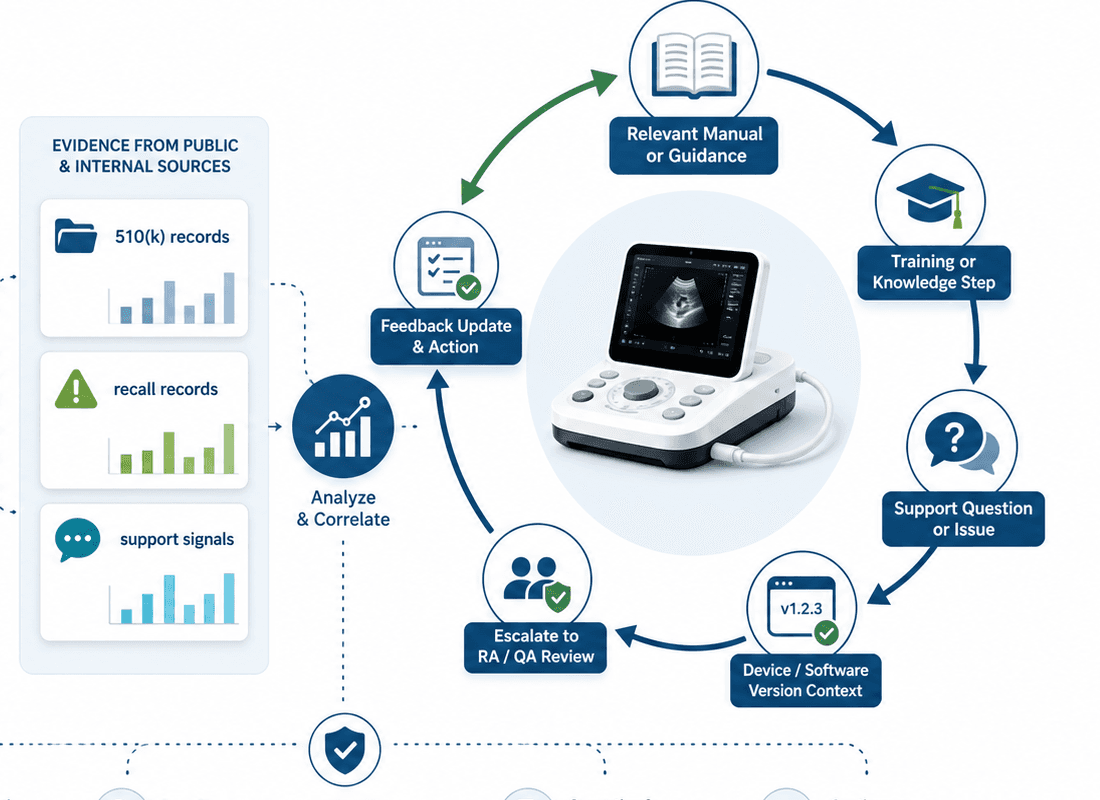
| Question | What the support-memory review map preserves |
|---|---|
| What did the user ask? | The exact question, role, use setting, and support channel. |
| What did they already see? | Search terms, manual section, training slice, video step, or support article. |
| Which version was involved? | Device model, accessory, software version, firmware, geography, or release context where known. |
| What answer was given? | The response, source basis, and any limitation attached to it. |
| What remained unresolved? | The user's remaining confusion, failed step, or repeated follow-up. |
| What should be reviewed? | The qualified-owner question, escalation route, and pattern signal. |
Why tickets alone miss the medical-device context
A ticket says, 'User asked X, support answered Y.' That may be enough when the product is low-risk and the answer is generic.
For a medical-device company, the same short exchange may hide important context:
- The user may have followed an outdated training step.
- The question may apply only to one device, accessory, or software version.
- The manual may answer the question, but not in the place users actually search.
- The support answer may be correct for one configuration and incomplete for another.
- Multiple users may be asking the same question in different words.
- The issue may need routing to support, training, field service, Regulatory Affairs / Quality Assurance (RA/QA), engineering, clinical review, supplier review, or another qualified owner.
Where public FDA records fit
Public records can help explain why support context matters, but they must be handled carefully.
A record-level exploratory check of U.S. Food and Drug Administration (FDA) openFDA data for 2020 through 2025 found:
| Record view | Record-level count |
|---|---|
| FDA 510(k) premarket notification records with decision dates in the period | 18,855 |
| Device recall records initiated in the same period | 15,856 |
| Recall records in that period with 510(k)-related numbers | 9,649 |
| Unique 510(k)-related references in those recall records | about 4,000 |
Why root-cause fields belong in the evidence layer
Examples in recall root-cause description fields included process control, device design, software design, nonconforming material/component, labeling design, and use error.
Those terms should not be used by a chatbot to classify a customer's issue. They should be used as a reminder that support questions may need a traceable context layer.
- Repeated confusion about one instruction may need training or labeling review.
- A question that appears after one release may need software-version context.
- A use-step question may depend on which training slice the user actually saw.
- A component or process-related question may require support, field service, supplier, quality, or engineering context before anyone can understand it.
What a support-memory review map captures
A practical support-memory map can start with one workflow or one recurring question set.
- User question: exact wording, user role, channel, date, and customer context where appropriate.
- Search path: what the user searched, opened, skipped, or repeated.
- Manual or training slice: the specific instruction, video step, support article, or knowledge card involved.
- Device and software version context: model, accessory, software version, firmware, configuration, or region where relevant.
- Support answer: the response given and the source behind it.
- Unresolved issue: what remained unclear or failed to resolve the question.
- Public or internal evidence referenced: source record, manual version, training version, support policy, or reviewed internal note.
- Escalation route: support owner, training owner, field service, RA/QA, engineering, clinical, supplier, or other qualified owner.
- Pattern signal: repeated wording, repeated workflow point, version clustering, distributor pattern, or training-content gap.
- Review question: the narrow question a qualified owner needs to answer.
Source ledger limits
The source ledger for this page separates official record fields from company-owned workflow recommendations.
| Source | Type and credibility | Main limit |
|---|---|---|
| FDA openFDA Device 510(k) API | Official public database; high credibility for record-level fields; accessed July 1, 2026. | Does not create a recall-rate denominator or decide predicate suitability, safety, effectiveness, compliance, clearance, or approval. |
| FDA openFDA Device Recall API | Official public database; high credibility for record-level recall fields; accessed July 1, 2026. | Does not decide complaint status, Medical Device Reporting, reportability, root cause, company quality, or device-level incidence. |
| FDA openFDA Device Enforcement API | Official public database; high credibility for public enforcement record fields; accessed July 1, 2026. | Does not compare company quality from counts alone. |
| FDA Mandatory Reporting Requirements | Official regulator page; high credibility for general Medical Device Reporting framework; accessed July 1, 2026. | Does not decide whether a specific support question is a complaint, reportable event, quality issue, or root-cause signal. |
| TrueMedDevice support-memory brief | Company first-party positioning; useful for artifact and workflow design. | Does not support FDA facts, compliance, safety, effectiveness, reportability, complaint status, or quality conclusions. |
What the system should not decide
A support-memory system should not decide whether something is a complaint. It should not decide Medical Device Reporting status, compliance, safety, effectiveness, clearance, approval, quality outcome, reportability, recall risk, or root cause.
It also should not imply that support memory prevents recalls or improves safety outcomes.
The boundary is simpler: organize the question, context, sources, unresolved issue, repeated pattern, and review route. Then qualified company owners and advisors decide what the signal means under the company's process.
A better first step than buying a generic tool
Before choosing a generic customer service tool or chatbot, map one real support workflow.
Pick one training session, one recurring support question, or one product-use step. Break it into source-linked scenario cards:
- what the user is trying to do;
- what they are likely to search;
- what training or manual slice they should see;
- which version details matter;
- what support can answer directly;
- what support should not answer directly;
- when the question routes to qualified review;
- what pattern signals should be watched over time.
Source ledger
What it can tell you
Official public database, high credibility for record-level 510(k) premarket notification fields. Accessed July 1, 2026; API last updated June 22, 2026. The 2020-2025 query returned 18,855 record-level results.
What it cannot decide
Device-level recall rates, predicate suitability, safety, effectiveness, compliance, clearance status beyond the public record, approval status, or whether a specific device is likely to be recalled.
What it can tell you
Official public database, high credibility for record-level recall fields. Accessed July 1, 2026; API last updated June 27, 2026. The 2020-2025 query returned 15,856 recall records, including 9,649 records with 510(k)-related numbers.
What it cannot decide
Recall rates, company quality comparisons, complaint classification, Medical Device Reporting status, reportability, root-cause truth for a specific case, device-level incidence, or final quality decisions.
What it can tell you
Official public database, high credibility for public enforcement recall records, classifications, recalling firms, distribution patterns, and recall-status context. Accessed July 1, 2026.
What it cannot decide
Whether one company has worse quality than another based only on record counts, because counts can reflect portfolio size, reporting structure, and record structure.
What it can tell you
Official regulator source, high credibility for FDA's Medical Device Reporting framework and reporting responsibilities for manufacturers, importers, and device user facilities. Accessed July 1, 2026.
What it cannot decide
Whether a specific support question is a complaint, a reportable event, a quality issue, a root-cause signal, or how a manufacturer should decide a specific event.
Frequently asked questions
Does this mean a support-memory system can prevent recalls?
No. It should not be described as recall prevention. The practical goal is to preserve context, organize repeated patterns, and route review questions to qualified owners.
Can a chatbot decide whether something is a complaint?
No. Complaint handling, Medical Device Reporting, quality decisions, and regulatory determinations belong inside the company's qualified process. A system can collect context and flag that review may be needed.
Why are long manuals and long training videos not enough?
They may contain the answer, but they often do not show what the user searched, which step they saw, which version was involved, what failed to help, or whether the same confusion is repeating.
Why include FDA/openFDA record counts?
They provide public record context for why source, version, training, support, and review paths can matter. They do not create a recall rate or decide anything about a specific device, company, support question, complaint, or reportable event.
Why not divide 510(k) records by recall records and call it a recall rate?
Because the records do not share one simple denominator. Recall records can repeat across products, events, firms, and corrections. A device-level or company-level rate requires deeper normalization and qualified interpretation.
What is the first workflow to map?
Start with one recurring support question, one training session, or one device-use step where users keep asking for help. Map the question, source content, version context, support answer, unresolved issue, escalation path, and qualified-review question.
Need to see where support context is getting lost?
Request the Customer Training & Support Memory overview to see how one training workflow or support question set can become searchable scenario cards with version context, source limits, escalation paths, and qualified-review questions.
Reader feedback
Useful pages should feed the next topic choices. Leave a signal or a short comment.